
Hornet Wars: The Battle for Hornet Gate – Final Dispatch
Updated: Nov 13, 2025
This is part II of the great Hornet Wars saga.
Please read Part I the Hornet Wars at
For unknown weeks, the Hornet Hordes controlled the only direct access between the western, and eastern agricultural territories that fed the busy, and hungry markets "my household" here in Southern Maryland.
The grape vines, the ripening blueberry groves, and the vast raspberry fields beyond the side gate.
They were there, ready, delicious, and calling for us to come and take part in their abundance!
But, alas, we were unprepared, we didn't even know they (the dreaded enemy, ground hornets) were there.
Feels like there is a lesson there..........
The Enemy
They held the gate, that pivotal chokepoint linking supply with demand with the determination of Spartans at Thermopylae — a fanatical, do-or-die defense of a narrow pass.
Their leaf-pile fortress "that the wind had created at a 90-degree angle where the gate met the rest of the chain link fence" served as both shield and staging ground.
This strategic area, dense cover, and illusion of peacefulness, allowed them to launch sudden blitzkrieg-style raids against any who dared approach!
Or in our case any unwary, unlucky, pedestrians trying to pass with baskets of fruit.
Like the Viet Cong, they knew the terrain intimately.
Using their dense cover, they emerged in swarming kamikaze sorties — striking hard, then vanishing into the shadows.
For the unprepared, their aggression was overwhelming. For the unarmed, near fatal, or at least pretty damned painful.
Pre-Phase I – The Road to War
The Hornet Hordes did not seize the gate in a day.
Months of relaxed posture, limited reconnaissance, and the absence of a standing intelligence network by the homestead "me" allowed enemy forces to quietly and invisibly establish a foothold at this critical strategic asset.
They surveyed the territory, slowly, quietly dug in, built up their numbers, trained fanatically, and were ready.
They went completely unnoticed until it was too late!
The gate — a vital artery between the agricultural territories, and markets — was left vulnerable.
The first strike came not against a regular household inhabitant, but against a high-value civilian target: the "Queen" Mother-in-Law who was visiting from the great white north, Toronto.
That brazen daylight attack against civilians who were casually transporting baskets of bounty transformed what had been an unknown pest problem into open warfare.
Each sting was a nail in the coffin of peace. No, we cannot all just get along. Not any longer.
And why did the Hornet Hordes dare such an act?
The answer is as old as war itself.
Philosophers have long debated why nations go to war, but the simplest truth is this:
Because they think they can win.
In their eyes, the terrain, their speed, and the complacency of the Allied forces gave them the advantage. (Plus, they are hornets, it is what they do).
The calculus was made. The gate was theirs and they intended to keep it. The war began.
(For a full account of the opening hostilities, see Hornet Wars Part I.)
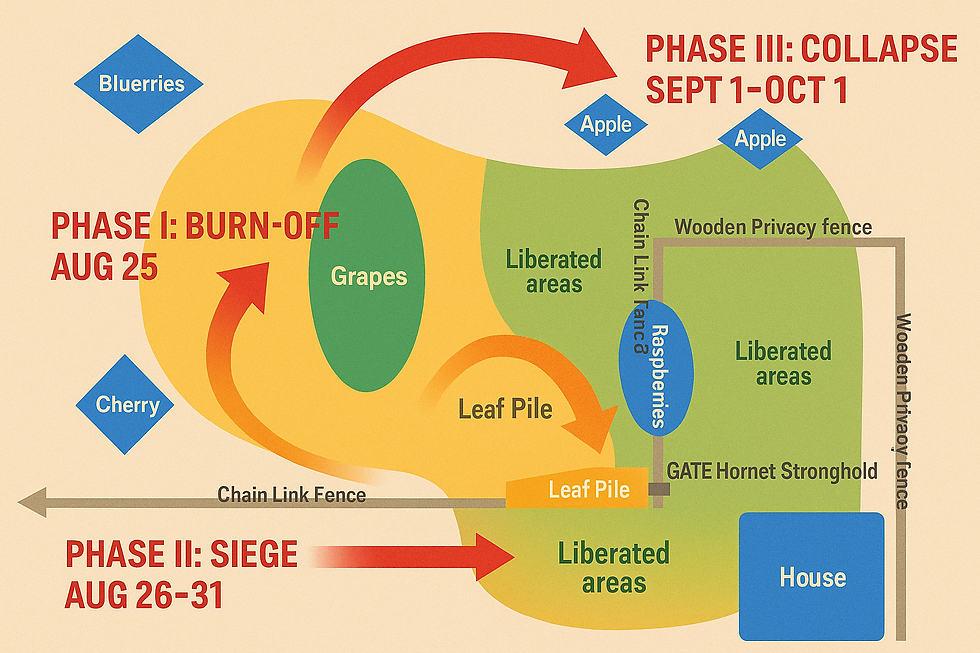
Phase I – The Burn-Off
The Allied forces "me" knew the key to breaking the stalemate was to strip away the cover.
In a move as old as warfare itself, controlled fire was brought to bear. Not Napalm this time, but good old-fashioned kerosene, and a match.
The leaf pile, once an impenetrable screen, burned away in minutes, revealing the hardened entry to Hornet Command Central.
An orange sized hole in the ground, with guards pouring out and surrounding the area with an angry buzzing sound!
Phase II – The Siege
With their concealment gone, precision chemical strikes (cans of wasp and hornet killer, 30-foot range) at dawn and dusk hammered the stronghold.
The Hornet supply sorties started to fail as the landing areas were now deadly.
Foraging units did not return, and allied strikes against them started to take their toll.
The hive began to wither; defenders who once filled the skies around the gate with angry buzzing and dive-bomb attacks now thinned out, their numbers dwindling, their morale breaking.
The age-old war of attrition waged on.
Phase III – The Collapse
As the Allied forces pounded the defenses daily, establishing air superiority by employing high tech (up to 30 feet away) chemical attacks.
The Hornets in a desperate, almost symbolic act, removed part of their own comb — perhaps to lighten the nest for evacuation, perhaps an unknown defender had brought the chemicals from the front line back and contaminated the comb?
Only the Hornet high command knew for sure. But for the Allies, it was a sign that victory was near.
Within a few more days, and cans of spray, the gate fell.
What had been Hornet High Command, legions of fanatical flying warriors bent on domination had now become a ruin.
Its corridors, combs, training grounds, and storage areas now silent save for the wind.
Liberation and Commerce Restored
Now, travelers, commerce, and family alike, move again, but with an uneasy freedom through the gate once more.
Merchants, gatherers, and family can take the direct route to the riches of the grape harbors, and berry bushes. The rare grapes once again change hands in open trade.
Blueberries and raspberries flow to market (and the kitchen table) unmolested.
Gone are the days of forced detours around the far side of the house, smuggling produce under the constant threat of attack.
An Uneasy Peace
And yet… the soil hums with unease.
Some believe pockets of Hornet resistance still linger underground, licking their wounds, gathering strength for a spring resurgence.
Reports filter in of lone Hornet marauders — buzzing near the gate but keeping their distance.
Perhaps true, or perhaps just a harmless honeybee mistaken for one of them…
Whether the Hornet Hordes rise again… only time will tell, but rest assured the Allies paid a heavy price and learned a hard lesson that will not be easily forgotten.
If you enjoyed this, please follow so you can get notified of new posts. Share with everyone that would enjoy this. Maybe buy me a coffee to just support the basic costs of running this site. Thank you!


Comments